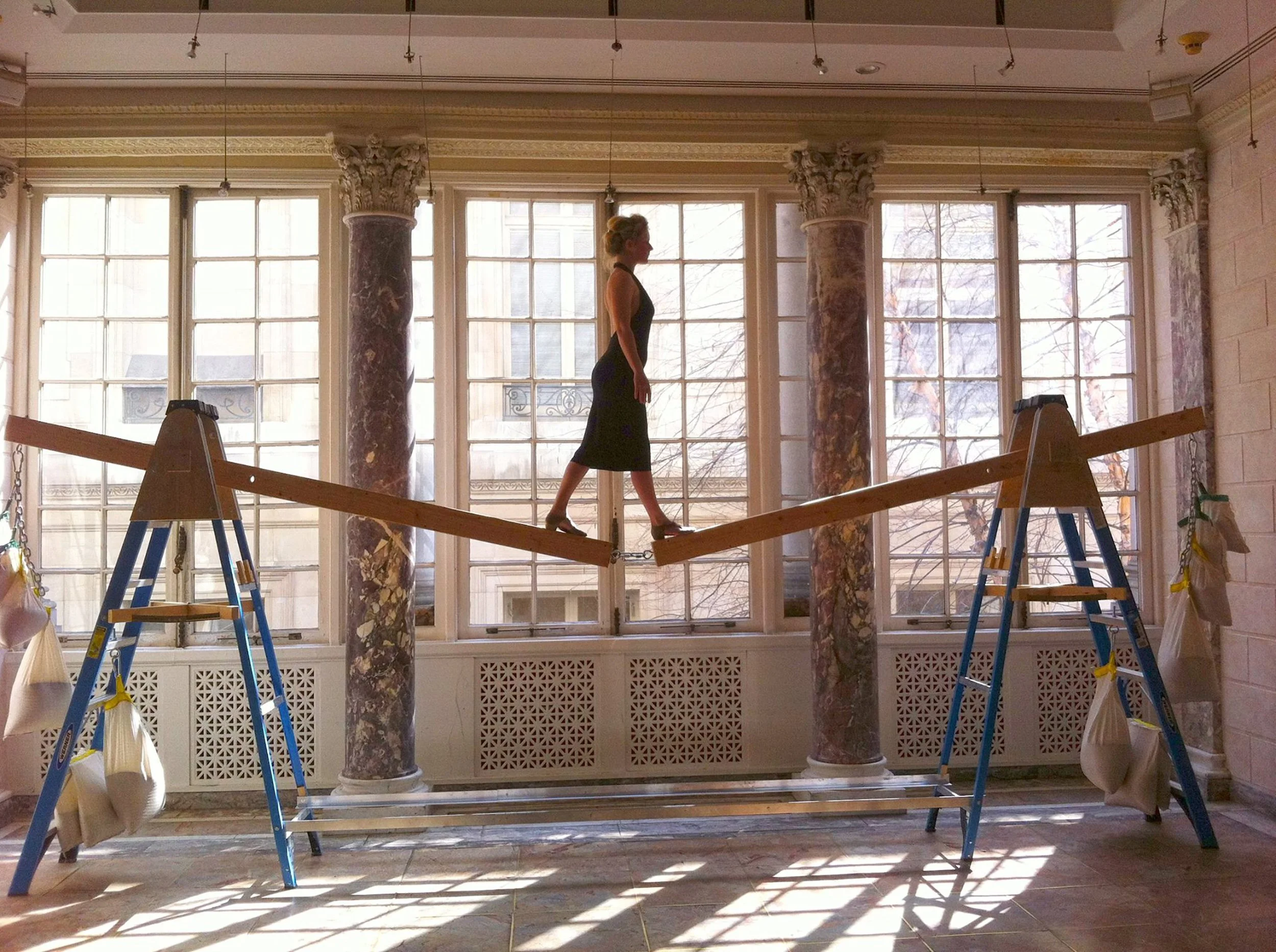
Ève Laroche-Joubert (born in Nancy, France, in 1975) lives and works between New York—where she spent twenty years—and Sète, where she settled in 2018. Her artistic practice centers on the senses of balance and proprioception (coordination and spatial awareness). She regards the human body as an intelligent perceptual structure in constant motion. Quoting Pascal’s Pensées, she envisions “a body full of thinking limbs.” Ève explores the relationship between body and mind, and how physical sensations can stimulate creativity and expand consciousness.
In the tradition of artist-engineers, she independently designs and constructs kinetic assemblages and large-scale ergonomic structures. Her work lies at the crossroads of sculpture, performance, dance, architecture, and design. Drawing from references that range from ancient totems to contemporary creations, her biomorphic sculptures evoke the vitality of living forms. Her Body-Space installations provide frameworks for choreographed performances, activated by herself or professional dancers.
“The pieces I create express the elegance of a gesture—a fleeting moment of balance that reflects our human condition,” she explains. Ève has collaborated with dancers in New York, in Moscow, and France, and has recently begun developing sculptures designed to be accessible to the public, including people with reduced mobilities. Her ongoing research investigates the unity of body and mind through the lenses of neuroscience, the humanities and philosophy, drawing particular inspiration from Paul Bach-y-Rita’s work on neuroplasticity, V.S. Ramachandran’s studies in behavioral neurology, and Riccardo Manzotti’s theories in externalist philosophy.
Her work has been exhibited in France, Germany, Switzerland, the Netherlands, Italy, Russia, and widely across the United States. She has participated in residencies supported by institutions such as Triangle Arts NYC, the Bemis Center for Contemporary Arts, the I-Park Foundation, Sculpture Space (U.S.), and the 3D Foundation in Verbier, Switzerland. Her projects have been featured in major publications including The New York Times, The Wall Street Journal, Artforum, The Brooklyn Rail, and Hyperallergic (U.S.); as well as Ouest France, Beaux-Arts Magazine, and Le Figaro Madame (France); Blouin Art Info (Russia); and Southern Metropolis Weekly (China), among others.
Ève graduated from the École Nationale Supérieure des Beaux-Arts in Paris and holds a Diplôme des Métiers d’Art in architectural metalwork with honors from the École Nationale Supérieure des Arts Appliqués et des Métiers d’Art (ENSAAMA Olivier de Serres) in Paris. From 1999 to 2001, she studied in California with the support of the Colin Lefranc Fellowship. During an exchange program at the New Genre department of the San Francisco Art Institute, she began integrating performance into her sculptural work.
She trained in classical ballet and music theory at the Conservatoire Régional de Musique de Lorraine and later practiced Capoeira in France, Germany, the Netherlands, Hungary, and the United States. Her experience in prototyping has enriched her fabrication methods: she has developed numerous prototypes in design and architecture and created works for the entertainment and contemporary art industries, including artworks for artists such as Olafur Eliasson and Urs Fischer. She has also worked as a construction site manager specializing in renovation in New York.
In parallel, Ève has taught perspective drawing at a private art school in Paris, focusing on the construction of anamorphoses. She authored an essay on an innovative perspectival system, published in the first issue of The Funambulist Magazine (2012), linking the discoveries of the Oakes artists with the research of architect and theorist Frederick John Kiesler on the concept of infinity.
Today, Ève Laroche-Joubert opens her practice to a much broader audience by developing accessible forms, conceived to be traversed, inhabited, and experienced corporeally. This evolution is notably embodied in her latest bird-observatory sculpture project, featured on the front page of the newspaper Le Monde, which she dedicates to young Talya, a wheelchair user living in the village of Vic-la-Gardiole in the south of France, where the work will be installed before spring 2026. In parallel, she continues her sculptural research centered on the body through forms devoid of any functionality, thereby affirming a fertile tension between potential use and formal freedom, between shared experience and the poetic autonomy of the object.
Ève Laroche-Joubert was also known under the pseudonym Eve Bailey from 2005 to 2015.