The ambitious BAM public art project around the Thau Archipelago announces its sites and artists
L’ambitieux projet BAM de nouvelles commandes d’art public autour de l’archipel de Thau dévoile ses lieux et ses acteurs
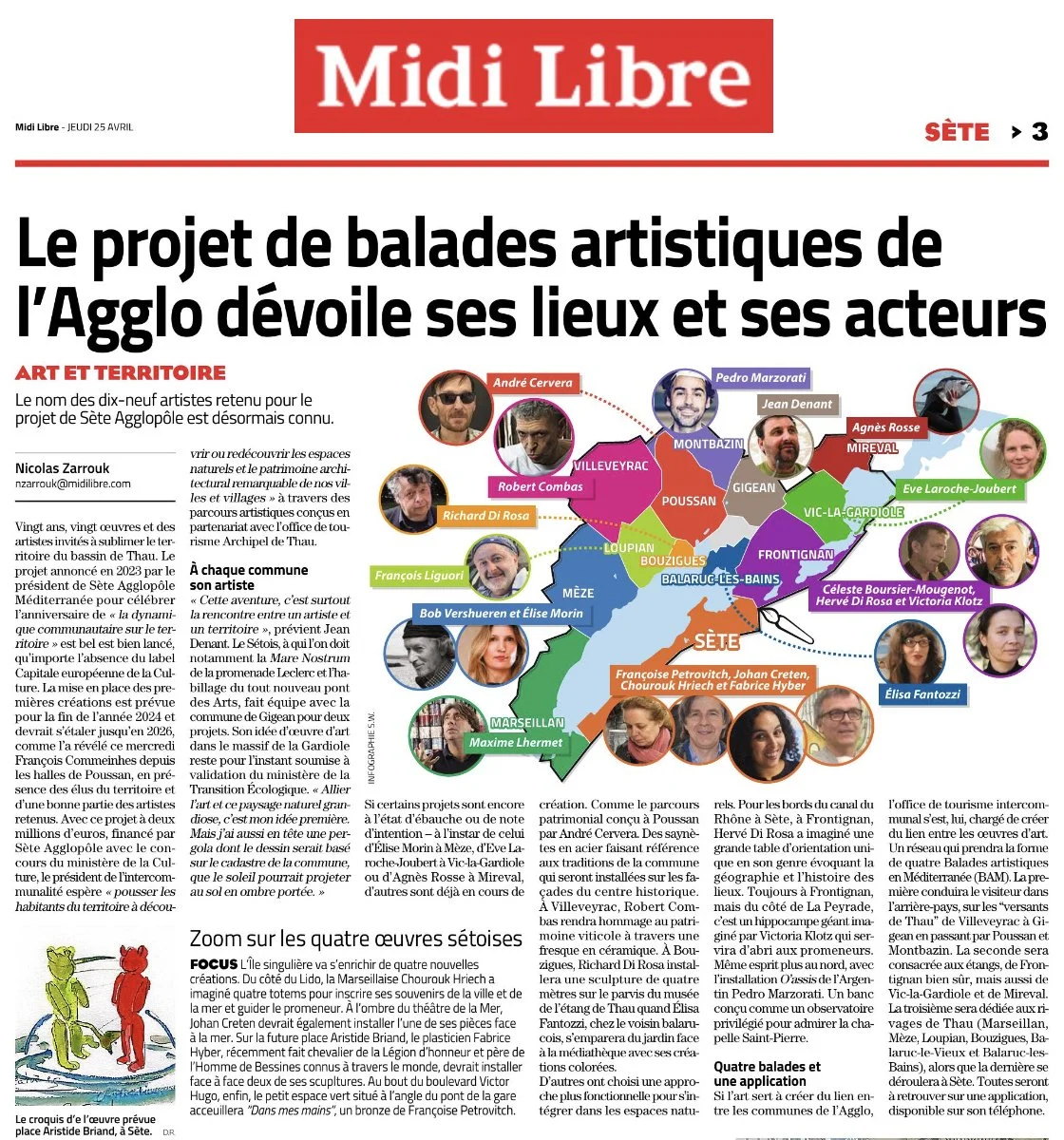
SELECTED ARTISTS
ARTISTES SÉLECTIONNÉS
Mèze – Bob Vershueren et Élise Morin
Villeveyrac – Robert Combas
Loupian – François Liguori
Bouzigues – Richard Di Rosa
Poussan – André Cervera
Gigean – Jean Denant
Balaruc-les-Bains – Élisa Fantozzi
Sète – Françoise Petrovitch, Johan Creten, Chourouk Hriech et Fabrice Hyber
Montbazin – Pedro Marzorati
Frontignan La Peyrade – Céleste Boursier-Mougenot, Hervé Di Rosa et Victoria Klotz
VIC-LA-GARDIOLE – EVE LAROCHE-JOUBERT
Mireval – Agnès Rosse
Marseillan – Maxime Lhermet
—————
MIDI LIBRE
April 25, 2024
Nicolas Zarrouk
“Artworks across the Thau Archipelago : which artists have been selected, and where will the works be located?”
Nineteen artists selected for the Sète Agglopôle project, now truly underway.
Twenty years, twenty artworks, the selected artists tasked with embellishing the Thau Basin’ territory. The project announced in 2023 by the president of Sète Agglopôle Méditerranée to celebrate the anniversary of “the community dynamic within the territory” is indeed moving forward, regardless of the absence of the European Capital of Culture label. The installation of the first creations is scheduled for the end of 2024 and should continue through 2026, as revealed this Wednesday by François Commeinhes from the Poussan market hall, in the presence of local elected officials and many of the selected artists.
With this two-million-euro project, funded by Sète Agglopôle with support from the Ministry of Culture, the president of the intermunicipal council hopes “to encourage residents to discover or rediscover the natural areas and remarkable architectural heritage of our towns and villages” through artistic itineraries designed in partnership with the Archipel de Thau Tourist Office.
“This adventure is above all the encounter between an artist and a territory,” warns Jean Denant. The Sète-based artist—known notably for the Mare Nostrum on the Leclerc promenade and for the design of the new Pont des Arts—has been paired with the commune of Gigean. His proposed artwork in the Gardiole massif is still awaiting approval from the Ministry of Ecological Transition. “Combining art and this magnificent natural landscape is my primary idea. But I also have in mind a pergola whose design would be based on the commune’s land registry, which the sun could project onto the ground as a shadow.”
While some projects are still at the sketch or concept-note stage—such as those of Élise Morin in Mèze, Eve Laroche-Joubert in Vic-la-Gardiole, or Agnès Rosse in Mireval—others are already underway. Such is the case for the heritage trail devised in Poussan by André Cervera: small steel scenes referencing local traditions that will be installed on the façades in the historic center. In Villeveyrac, Robert Combas will pay tribute to the region’s winegrowing heritage through a ceramic mural. In Bouzigues, Richard Di Rosa will install a four-meter sculpture on the forecourt of the Thau Lagoon Museum, while in neighboring Balaruc, Élisa Fantozzi will transform the garden in front of the media library with her colorful creations.
A closer look at the four Sète-based works.
Focus. The Île Singulière will gain three new creations. On the Lido side, Marseille-born Chourouk Hriech has envisioned four totems to inscribe her memories of the city and the sea, guiding walkers along the way. In the shade of the Théâtre de la Mer, Johan Creten is also expected to install one of his pieces facing the water. On the future Aristide Briand Square, visual artist Fabrice Hyber—recently made a Chevalier of the Légion d’Honneur and father of the globally known Homme de Bessines—is expected to place two of his sculptures facing each other. Finally, at the end of Boulevard Victor Hugo, the small green space at the corner of the station bridge will host In My Hands, a bronze by Françoise Pétrovitch.
Others have chosen a more functional approach to blend into the natural surroundings. Along the Rhône-to-Sète canal in Frontignan, Hervé Di Rosa has imagined a large, one-of-a-kind orientation table evoking the geography and history of the area. Still in Frontignan, but on the La Peyrade side, a giant seahorse designed by Victoria Klotz will serve as a shelter for walkers. The same spirit can be found further north with O’assis, an installation by the Argentine artist Pedro Marzorati — a bench conceived as a privileged viewpoint from which to admire the Saint-Pierre chapel.
Four artistic walks across the territory.
While art serves to create connections between the municipalities of the Agglo, the intermunicipal tourist office has taken on the task of creating connections between the artworks themselves. This network will take the form of four Artistic Walks in the Mediterranean (BAM). The first will lead visitors through the hinterland, along the “slopes of Thau,” from Villeveyrac to Gigean via Poussan and Montbazin. The second focuses on the lagoons—Frontignan of course, but also Vic-la-Gardiole and Mireval. The third is dedicated to the shores of the Thau Lagoon (Marseillan, Mèze, Loupian, Bouzigues, Balaruc-le-Vieux, and Balaruc-les-Bains), while the last will take place in Sète.
“A sensitive link between art and heritage”
Until a few months ago still the director of the national stage in Annecy, the Sète native Salvador Garcia is the artistic curator of the program. This Wednesday, he presented these Artistic Walks in the Mediterranean as “a sensitive thread connecting the remarkable elements of heritage and natural sites, thanks to the perspectives of artists who, for the most part, live around the Thau Basin or have a connection to it.”
A project not so easy to implement. “It is never simple to choose an artist’s aesthetic and associate it with a territory. We know from the outset that it will not necessarily please everyone. But we are not talking here about purchasing existing works. The artists are engaging in the act of creation, after long discussions with elected officials. And it worked!”
Balades artistiques à travers l'Agglo de Sète : qui sont les artistes retenus et où seront situées les œuvres ?
Dix-neuf artistes retenus pout le projet de Sète Agglopôle, désormais bel et bien lancé.
Vingt ans, vingt œuvres et des artistes invités à sublimer le territoire du bassin de Thau. Le projet annoncé en 2023 par le président de Sète Agglopôle Méditerranée pour célébrer l’anniversaire de "la dynamique communautaire sur le territoire" est bel est bien lancé, qu’importe l’absence du label Capitale européenne de la Culture. La mise en place des premières créations est prévue pour la fin de l’année 2024 et devrait s’étaler jusqu’en 2026, comme l’a révélé ce mercredi François Commeinhes depuis les halles de Poussan, en présence des élus du territoire et d’une bonne partie des artistes retenus. Avec ce projet à deux millions d’euros, financé par Sète Agglopôle avec le concours du ministère de la Culture, le président de l’intercommunalité espère "pousser les habitants du territoire à découvrir ou redécouvrir les espaces naturels et le patrimoine architectural remarquable de nos villes et villages" à travers des parcours artistiques conçus en partenariat avec l’office de tourisme Archipel de Thau.
À chaque commune son artiste.
"Cette aventure, c’est surtout la rencontre entre un artiste et un territoire", prévient Jean Denant. Le Sétois, à qui l’on doit notamment la Mare Nostrum de la promenade Leclerc et l’habillage du tout nouveau pont des Arts, fait équipe avec la commune de Gigean. Son idée d’œuvre d’art dans le massif de la Gardiole reste pour l’instant soumise à validation du ministère de la Transition Écologique. "Allier l’art et ce paysage naturel grandiose, c’est mon idée première. Mais j’ai aussi en tête une pergola dont le dessin serait basé sur le cadastre de la commune, que le soleil pourrait projeter au sol en ombre portée."
Si certains projets sont encore à l’état d’ébauche ou de note d’intention – à l’instar de celui d’Élise Morin à Mèze, d’Ève Laroche-Joubert à Vic-la-Gardiole ou d’Agnès Rosse à Mireval, d’autres sont déjà en cours de création. Comme le parcours patrimonial conçu à Poussan par André Cervera. Des saynètes en acier faisant référence aux traditions de la commune qui seront installées sur les façades du centre historique. À Villeveyrac, Robert Combas rendra hommage au patrimoine viticole à travers une fresque en céramique. À Bouzigues, Richard Di Rosa installera une sculpture de quatre mètres sur le parvis du musée de l’étang de Thau quand Élisa Fantozzi, chez le voisin balarucois, s’emparera du jardin face à la médiathèque avec ses créations colorées.
Zoom sur les quatre œuvres sétoises.
Focus. L’Île singulière va s’enrichir de trois nouvelles créations. Du côté du Lido, la Marseillaise Chourouk Hriech a imaginé quatre totems pour inscrire ses souvenirs de la ville et de la mer et guider le promeneur. À l’ombre du théâtre de la Mer, Johan Creten devrait également installer l’une de ses pièces face à la mer. Sur la future place Aristide Briand, le plasticien Fabrice Hyber, récemment fait chevalier de la Légion d’honneur et père de l’Homme de Bessines connus à travers le monde, devrait installer face à face deux de ses scupltures. Au bout du boulevard Victor Hugo, enfin, le petit espace vert situé à l’angle du pont de la gare acceuillera “Dans mes mains”, un bronze de Françoise Petrovitch.
D’autres ont choisi une approche plus fonctionnelle pour s’intégrer dans les espaces naturels. Pour les bords du canal du Rhône à Sète, à Frontignan, Hervé Di Rosa a imaginé une grande table d’orientation unique en son genre évoquant la géographie et l’histoire des lieux. Toujours à Frontignan, mais du côté de La Peyrade, c’est un hippocampe géant imaginé par Victoria Klotz qui servira d’abri aux promeneurs. Même esprit plus au nord, avec l’installation O’assis de l’Argentin Pedro Marzorati. Un banc conçu comme un observatoire privilégié pour admirer la chapelle Saint-Pierre.
Quatre balades artistiques à travers le territoire.
Si l’art sert à créer du lien entre les communes de l’Agglo, l’office de tourisme intercommunal s’est, lui, chargé de créer du lien entre les œuvres d’art. Un réseau qui prendra la forme de quatre Balades artistiques en Méditerranée (BAM). La première conduira le visiteur dans l’arrière-pays, sur les "versants de Thau" de Villeveyrac à Gigean en passant par Poussan et Montbazin. La seconde est consacrée aux étangs, de Frontignan bien sûr, mais aussi de Vic-la-Gardiole et de Mireval. La troisième est consacrée aux rivages de Thau (Marseillan, Mèze, Loupian, Bouzigues, Balaruc-le-Vieux et Balaruc-les-Bains), alors que la dernière se déroulera à Sète.
"Un lien sensible entre l’art et le patrimoine"
Jusqu’à il y a quelques mois encore directeur de la scène nationale d’Annecy, le Sétois Salvador Garcia est le commissaire artistique du programme. Ce mercredi, il a présenté ces Balades artistiques en Méditerranée comme "un lien sensible pour relier les élements remarquables des sites patrimoniaux et naturels grâce au regard d’artistes qui, pour beaucoup, vivent sur le bassin de Thau où ont un lien avec lui."
Un projet pas si simple à mettre en place. "Il n’est jamais facile de choisir l’esthétique d’un artiste pour l’associer à un territoire. On sait d’avance qu’il ne plaira pas forcément à tout le monde. Mais on ne parle pas ici d’achat d’œuvres existantes. Les artistes se prêtent au jeu de la création, après avoir échangé longuement avec les élus. Et ça a fonctionné !"
