Drunken Body Up & Down
2007
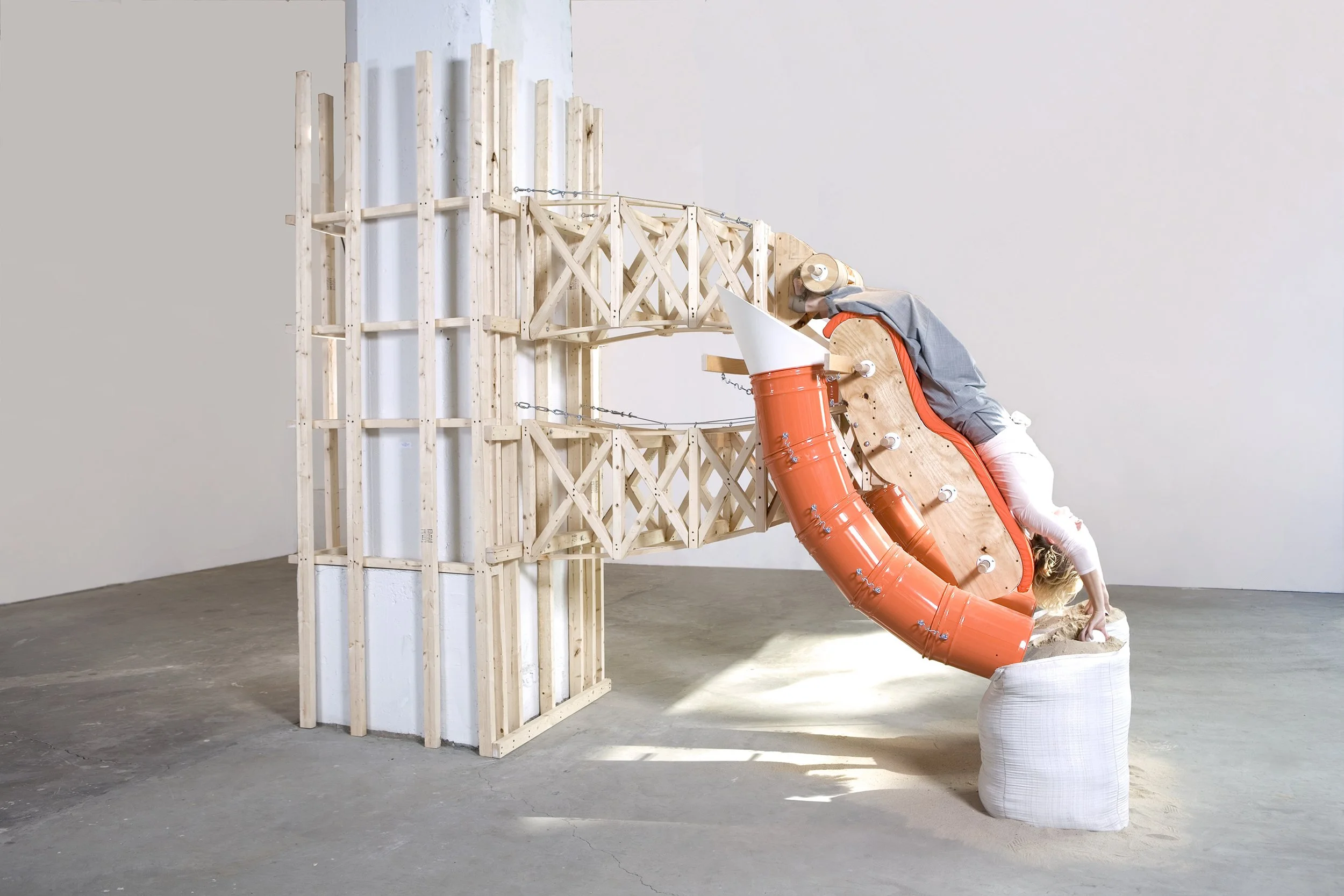
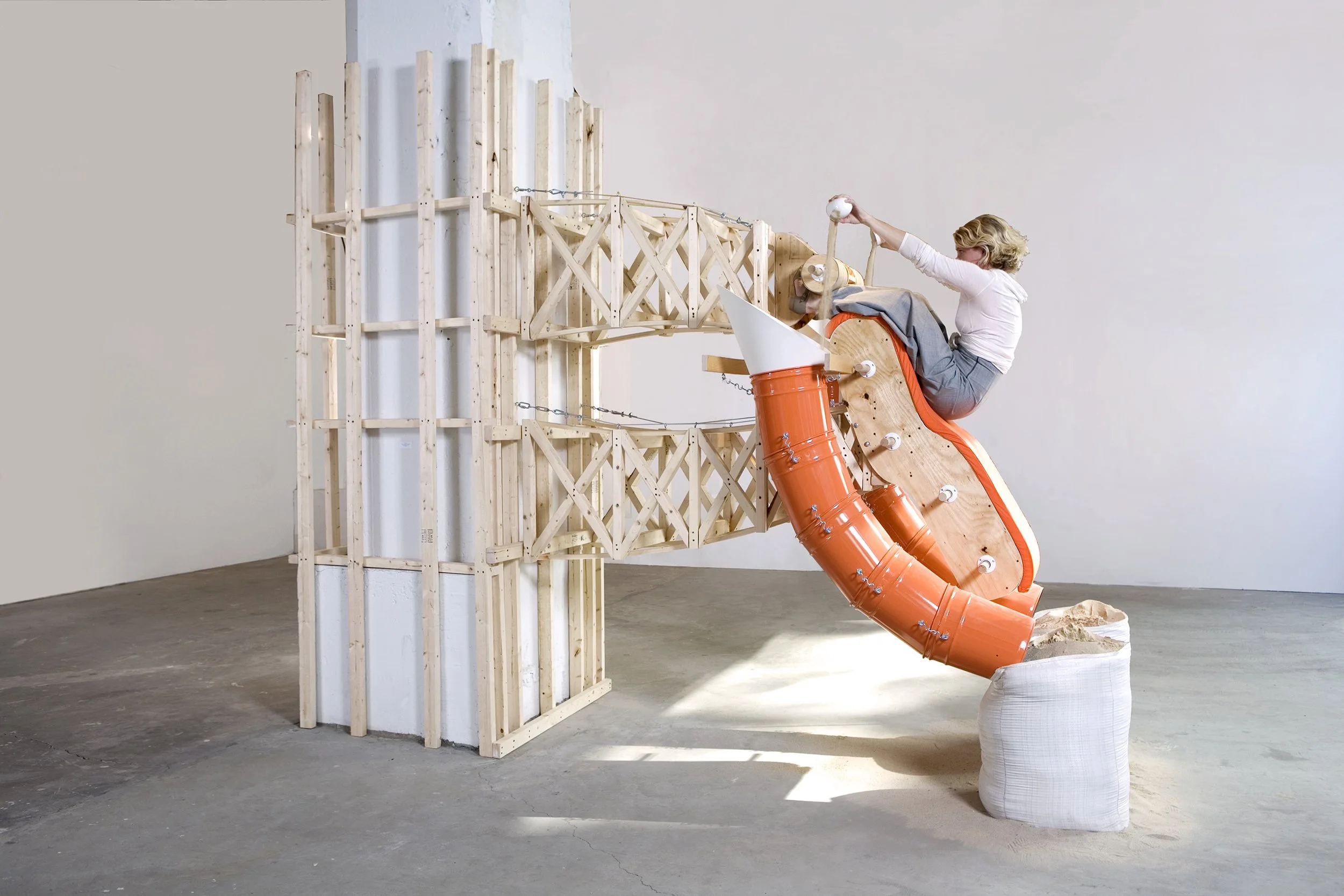
Drunken Body Up & Down are two photographs conceived as a relay of the performance, in which real-time action extends into the field of the image. Like Shoulder Path Sequence, these images are neither spectacular documentation nor simple records of a past action; they were conceived as tools of legibility, capable of making perceptible the bodily and mental logic at work in the sculpture Drunken Body. By isolating two key moments of the gesture—the inverted, suspended body engaged in the effort of filling and emptying sand—the photographs condense the cyclical, absurd, and physically demanding movement that runs through the performance.
Here, the body appears less as an expressive subject than as a knowing body, operating in an automatic mode, stripped of narrative intention, according to an economy of gesture akin to training, repetition, and endurance. The tension between control and release, calculated balance, is rendered with precision: the architectural device, the counterweight system, and the color orange—a functional signal—compose a visual language in which the body of the artist becomes the temporary activator of a sculpture already charged with movement. Drunken Body Up & Down thus extend the performance into the realm of the image, not to freeze the action, but to convey its inner mechanics: a gesture without resolution, poised between humor and cruelty, in which the contemporary body is shaped, constrained, and endlessly repeated.
Corps Ivre en Suspension
2007
Corps Ivre en Suspension sont deux photographies conçues comme un relais de la performance, où l’action en temps réel se prolonge dans le champ de l’image. À l’instar de Séquence du Chemin de l’Épaule, ces images ne relèvent ni de la documentation spectaculaire ni du simple enregistrement d’une action passée : elles ont été pensées comme des outils de lisibilité, capables de rendre perceptible la logique corporelle et mentale à l’œuvre dans la sculpture Corps Ivre. En isolant deux moments-clés du geste — le corps inversé, suspendu, pris dans l’effort de remplir et de vider le sable — les photographies condensent le mouvement cyclique, absurde et éprouvant qui traverse la performance.
Le corps y apparaît moins comme un sujet expressif que comme un corps qui sait, agissant en mode automatique, vidé de toute intention narrative, selon une économie du geste proche de l’entraînement, de la répétition et de l’endurance. La tension entre maîtrise et abandon, équilibre calculé, s’y inscrit avec précision : le dispositif architectural, le système de contrepoids et la couleur orange — signal fonctionnel — composent un langage visuel où le corps de l’artiste devient l’activateur temporaire d’une sculpture déjà chargée de mouvement. Corps Ivre en Suspension prolongent ainsi la performance dans le champ de l’image, non pour en figer l’action, mais pour en transmettre la mécanique intérieure : un geste sans résolution, entre humour et cruauté, où le corps contemporain se façonne, se contraint et se répète.