The Villager / 01-2024
‘Falling Sideways’: East Village show explores the etherial aspects of life and the universe.
(…) Sculptor Eve Laroche-Joubert created the minimalist set (…)
The (…) goings-on are played out on a minimal set from the talented Laroche-Joubert.
In the center of the black box theater is a large white seesaw adorned with a blanket and a pillow, created for its ability to lift the actors up and to provide some visual metaphors.
Of the prop, the designer says, “You could express so many literal, poetical and metaphorical scenes. Shifting weight, losing balance, recovering balance, moving, rocking are all inspiring and dynamic gestures. The simpler the object, the more imaginative the actors can be.”
« Basculer de Travers » : une pièce de théâtre dans l’East Village explore les dimensions célestes de la vie et de l’univers.
(…) La sculptrice Eve Laroche-Joubert a créé le décor minimaliste (…)
Les (…) événements se déroulent sur un dispositif scénique épuré imaginé par la talentueuse Laroche-Joubert.
Au centre du black box theater se trouve une grande balancelle blanche, recouverte d’une couverture et d’un oreiller, conçue pour soulever les acteurs et offrir plusieurs métaphores visuelles.
À propos de cet accessoire, la créatrice explique : « Cet objet permet d’exprimer une multitude de scènes littérales, poétiques ou métaphoriques. Le déplacement du poids, la perte d’équilibre, le retour à l’équilibre, le mouvement, le balancement sont autant de gestes inspirants et dynamiques. Plus l’objet est simple, plus les acteurs peuvent déployer leur imagination. »
January 2024
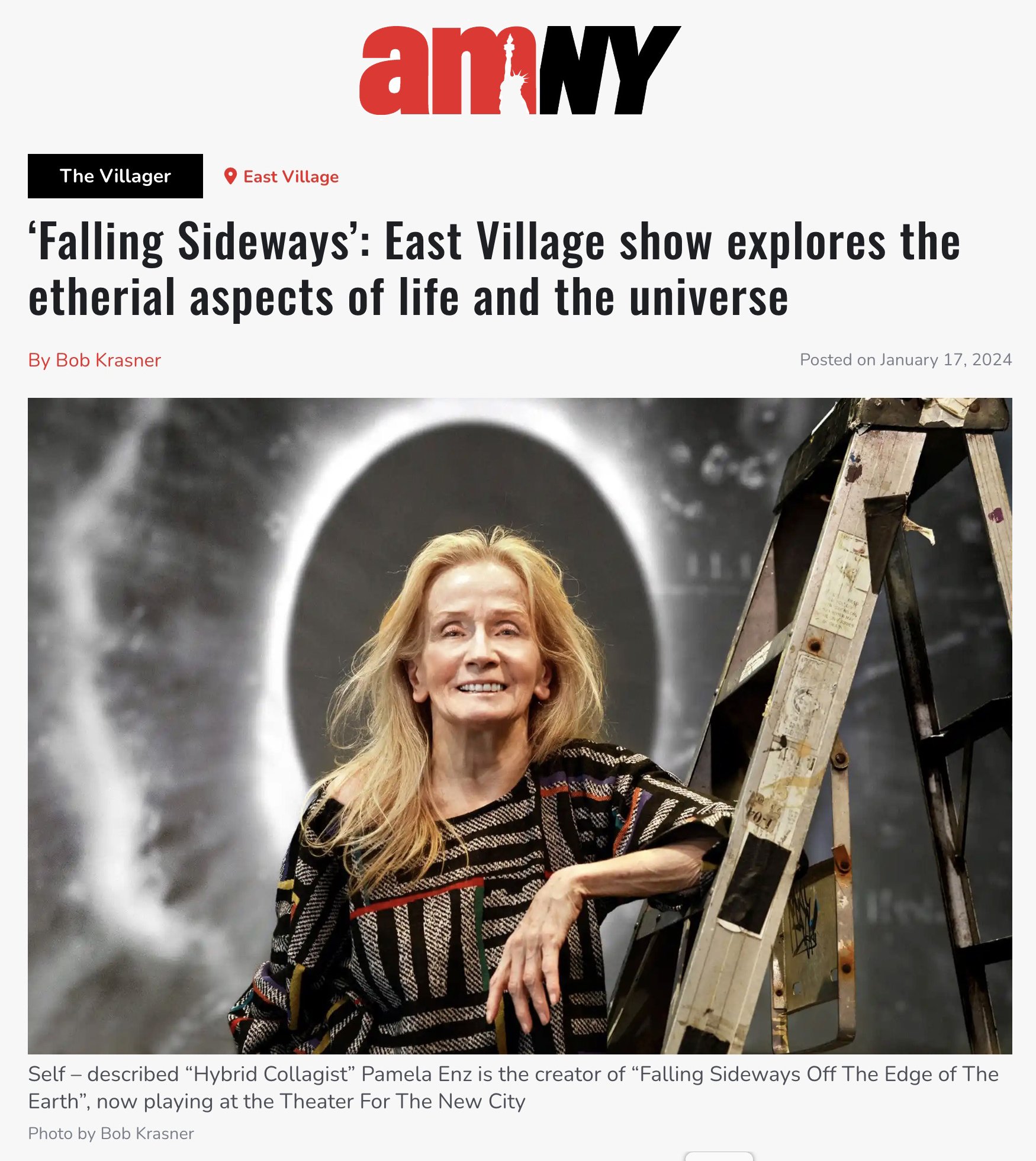
No one can accuse Pamela Enz of not tackling the big questions.
Life, death, afterlife, sex, physics, the zeitgeist, mysticism, the nature of the universe and the fate of humanity are all touched on in Enz’s latest play, “Falling Sideways Off The Edge Of The Earth,” now playing at the Theater for the New City in the East Village.
While the non-linear production sprung from Enz’s pen, the team that collaborated with her made strong contributions to the current staging. Sculptor Eve Laroche-Joubert created the minimalist set; Joan Pope contributed rapid-fire black-and-white video backgrounds that change from scene to scene; Elliott Randall wrote the music; and C.C. Kellogg and Avery Wigglesworth co-directed an energetic cast.
Enz has been working on this one for awhile now — “decades!” she says, laughing.
“That includes latent periods when life was teaching me one thing on the surface while beneath my passions patiently waited to surface,” Enz explains. “I never set out to do something … but a certain gestation takes place before a story is born from out of a pile of notes, monologues, various lines sprung from my own consciousness or being alert and sensitive to the marvelous things one can hear people say out loud passing one on the street “.
Co-director Kellogg remarks that “Pam has a very unique style and voice” and notes that the play “is also structurally unusual, kaleidoscopic rather than traditionally narrative.” She relates that while working with a non-linear play is a challenge, it’s also a delight.
“The main challenge is how to stage such an unusual world,” Kellogg says. “A world that shifts between timescales, in the liminal space between life and death. Nothing felt set in stone, which gave us so much room to explore in rehearsals. I hope people enjoy that openness and feel free to bring their own interpretation to the text, which is surrealist but has a real beating heart in its mother/daughter narrative. It has been such a pleasure to interpret and play in the world of ‘Falling.'”
Wigglesworth also mentions the play’s uniqueness and makes a case for its structure.
“The human heart and mind cannot be wrapped neatly into a simple narrative, not when you take into account all of the inexplicable magic and mysteries of the world,” she says. “This play embraces the abstract — in everything from plot to sentence structure — in an attempt to offer a theatrical experience that’s more akin to our actual human existence.”
Enz praises everyone involved for their contributions, with special mentions for a cast that digs into a demanding script. The characters include a virgin bride, a vagabond mystic, a puppet and a ghost (or two).
“C.C. and Avery cast an amazing troupe of actors including Gina Hoben who made the lead her very own, Marlon Xavier who shines within a powerhouse of female mega talent that includes Violet Savage, Ana Semedo and Karen Cecilia, who delicately balances science and mysticism in her portal of the physicist,” she says.
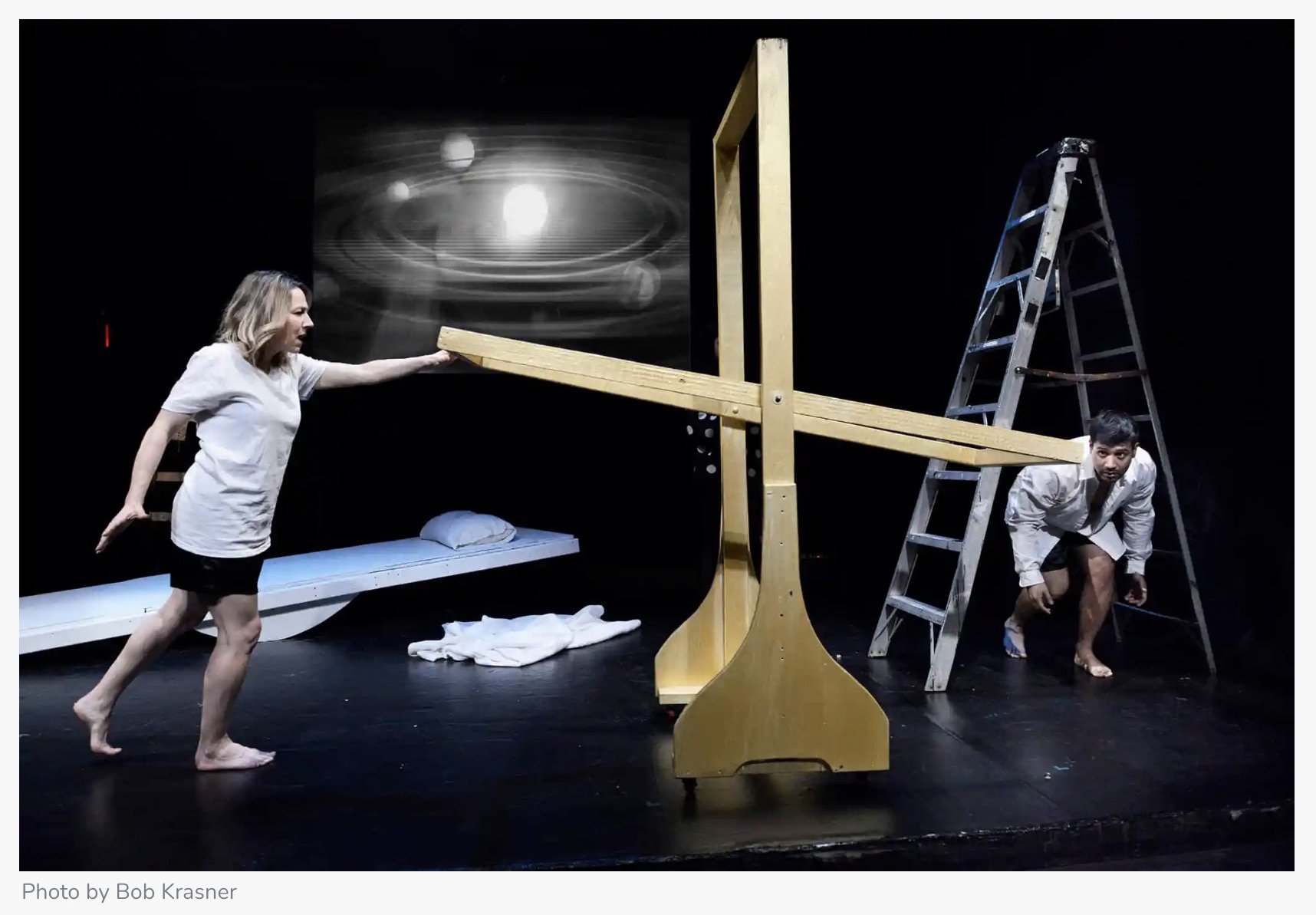
The dense (and sometimes exhausting) goings-on are played out on a minimal set from the talented Laroche-Joubert.
In the center of the black box theater is a large white seesaw adorned with a blanket and a pillow, created for its ability to lift the actors up and to provide some visual metaphors.
Of the prop, the designer says, “You could express so many literal, poetical and metaphorical scenes! Shifting weight, losing balance, recovering balance, moving, rocking are all inspiring and dynamic gestures.The simpler the object, the more imaginative the actors can be!”
Randall, who first made his mark in popular culture by playing some indelible lead guitar on early Steely Dan classics, came to the project without any “preconceived notions about the music I would compose to support the drama.”
He relates that, “I’ve written for plays and for films before. The music is always there to enhance the presentation. Sometimes it’s ‘in your face’ and other times it’s a subtle aural backdrop — much as in good cinema. What I love about Pam’s writing is that it’s ‘no holds barred/take no prisoners’ — which allows me to take my ideas to the furthest reaches of composition. It’s a dream come true!”
Enz, who continued to tweak the show right up to opening night, had a few life experiences that affected the work — including the passing of both of her parents, her introduction to the Italian physicist, Pier Luigi Capucci, and her discovery of the establishment of Mysterianism, a strand of thinking that posits that even though there is nothing supernatural about how consciousness arises from neural activity, the human brain is simply not equipped to understand it.
In other words, our brains are not really capable of understanding our brains.
“I truly believe that the universe is one being,” Enz explains. “All of its parts are different expressions of the same energy, in communication with and influencing each other — therefore parts of one organic whole.”
She notes one thing that she hopes the audience will take away from her work: “I’d like them to take away the scientifically-accepted miraculous — that every living being is born of the exact same stardust as ourselves. That we mistakenly seek to narrow down life, that screaming bundle of uncertainty, to the imaginable to deal with our fear of loss — the certain loss that accompanies all of life and love terrifying us into wasting time when we might instead exalt in the privilege of having emerged from the nothingness of everything.”
“Falling Sideways” runs through Jan. 28. Show info and tickets are at theaterforthenewcity.net/
Personne ne peut accuser Pamela Enz de ne pas s’attaquer aux grandes questions.
La vie, la mort, l’au-delà, le sexe, la physique, l’esprit du temps, le mysticisme, la nature de l’univers et le destin de l’humanité sont autant de thèmes abordés dans la dernière pièce d’Enz, « Falling Sideways Off The Edge Of The Earth », actuellement à l’affiche au Theater for the New City, dans l’East Village.
Si cette production non linéaire est sortie de la plume d’Enz, l’équipe qui a collaboré avec elle a apporté une contribution décisive à la mise en scène actuelle. La sculptrice Eve Laroche-Joubert a créé le décor minimaliste ; Joan Pope a conçu les arrière-plans vidéo en noir et blanc, rapides et changeant d’une scène à l’autre ; Elliott Randall a composé la musique ; et C.C. Kellogg et Avery Wigglesworth ont co-mis en scène une troupe pleine d’énergie.
Enz travaille sur ce projet depuis un bon moment — « des décennies ! », dit-elle en riant.
« Cela inclut des périodes latentes où la vie m’enseignait une chose en surface alors que, en profondeur, mes passions attendaient patiemment de remonter à la surface », explique Enz. « Je ne pars jamais avec l’intention de faire quelque chose… mais une certaine gestation a lieu avant qu’une histoire ne naisse d’un tas de notes, de monologues, de diverses lignes surgies de ma propre conscience ou issues de ma vigilance devant les choses merveilleuses que l’on peut entendre dans la rue, dites à voix haute par des inconnus en passant. »
La co-metteuse en scène Kellogg remarque que « Pam a un style et une voix vraiment uniques » et souligne que la pièce « est également structurellement inhabituelle, kaléidoscopique plutôt que narrative au sens traditionnel ». Elle confie que travailler sur une pièce non linéaire représente un défi, mais aussi une source de plaisir.
« Le principal défi est de mettre en scène un monde aussi inhabituel », explique Kellogg. « Un monde qui oscille entre différentes échelles temporelles, dans cet espace liminaire entre la vie et la mort. Rien ne semblait figé, ce qui nous a offert une immense liberté d’exploration pendant les répétitions. J’espère que le public appréciera cette ouverture et se sentira libre d’apporter sa propre interprétation au texte, qui est surréaliste mais possède un véritable cœur battant dans sa trame mère/fille. Interpréter et jouer dans l’univers de Falling a été un véritable plaisir. »
Wigglesworth évoque elle aussi l’originalité de la pièce et défend sa structure.
« Le cœur et l’esprit humains ne peuvent pas être enfermés dans un récit simple, pas lorsque l’on tient compte de toute la magie inexplicable et des mystères du monde », dit-elle. « Cette pièce embrasse l’abstraction — que ce soit dans l’intrigue ou dans la structure des phrases — afin de proposer une expérience théâtrale plus proche de notre existence humaine réelle. »
Enz salue toutes les personnes impliquées pour leurs contributions, avec une mention spéciale pour une distribution qui se confronte à un texte exigeant. Les personnages incluent une mariée vierge, un mystique vagabond, une marionnette et un fantôme (ou deux).
« C.C. et Avery ont réuni une troupe d’acteurs formidable, dont Gina Hoben qui s’est totalement approprié le rôle principal, Marlon Xavier qui brille au cœur d’une équipe féminine impressionnante composée de Violet Savage, Ana Semedo et Karen Cecilia, qui équilibre avec délicatesse science et mysticisme dans son incarnation de la physicienne », dit-elle.
Les péripéties denses — et parfois épuisantes — se déroulent sur un décor minimaliste conçu par la talentueuse Laroche-Joubert.
Au centre du black box theater se trouve une grande bascule blanche ornée d’une couverture et d’un oreiller, conçue pour soulever les acteurs et fournir plusieurs métaphores visuelles.
À propos de cet accessoire, la scénographe explique :
« On peut exprimer tant de scènes littérales, poétiques ou métaphoriques ! Déplacer le poids, perdre l’équilibre, le retrouver, bouger, se balancer… autant de gestes inspirants et dynamiques. Plus l’objet est simple, plus les acteurs peuvent faire preuve d’imagination ! »
Randall, qui s’est fait connaître dans la culture populaire grâce à ses lignes de guitare mémorables sur les premiers classiques de Steely Dan, est arrivé sur le projet « sans aucune idée préconçue concernant la musique que je composerais pour soutenir la dramaturgie ».
Il explique :
« J’ai déjà écrit pour le théâtre et le cinéma. La musique est toujours là pour renforcer la présentation. Parfois, elle est très présente, d’autres fois elle sert de toile de fond sonore subtile — comme dans un bon film. Ce que j’aime dans l’écriture de Pam, c’est qu’elle est no holds barred/take no prisoners — ce qui me permet de pousser mes idées vers les extrêmes de la composition. C’est un rêve devenu réalité ! »
Enz, qui a continué d’ajuster le spectacle jusqu’à la soirée d’ouverture, a vécu plusieurs expériences marquantes qui ont influencé l’œuvre — notamment la perte de ses deux parents, sa rencontre avec le physicien italien Pier Luigi Capucci, et sa découverte du « mystérianisme », une approche philosophique affirmant que, même s’il n’y a rien de surnaturel dans la façon dont la conscience émerge de l’activité neuronale, le cerveau humain n’est tout simplement pas équipé pour le comprendre.
En d’autres termes, notre cerveau n’est pas réellement capable de se comprendre lui-même.
« Je crois profondément que l’univers est un seul être », explique Enz. « Toutes ses parties sont des expressions différentes de la même énergie, en communication et en interaction les unes avec les autres — donc les parties d’un tout organique. »
Elle souligne ce qu’elle espère que le public retiendra de son travail :
« J’aimerais qu’ils retiennent le miraculeux — accepté scientifiquement — que tout être vivant est né de la même poussière d’étoiles que nous. Que nous cherchons à tort à réduire la vie, cette masse hurlante d’incertitude, à ce qui est imaginable pour affronter notre peur de la perte — la perte inéluctable qui accompagne toute vie et tout amour, nous terrorisant au point de nous faire perdre du temps au lieu de nous exalter d’avoir émergé du néant de toutes choses. »
“Falling Sideways” est à l’affiche jusqu’au 28 janvier. Informations et billets sur theaterforthenewcity.net.
