Paris La Douce / 05-2023
A full article on the artistic approach of Ève Laroche-Joubert and a close-up on the sculpture Entasis Dance V, acquired by the city of Sète in 2022, by Caroline Hauer, May 6, 2023.
Article complet sur la démarche artistique d’Ève Laroche-Joubert et un gros plan sur la sculpture “Entasis Dance V” acquise par la ville de Sète en 2022, par Caroline Hauer, 6 mai 2023.
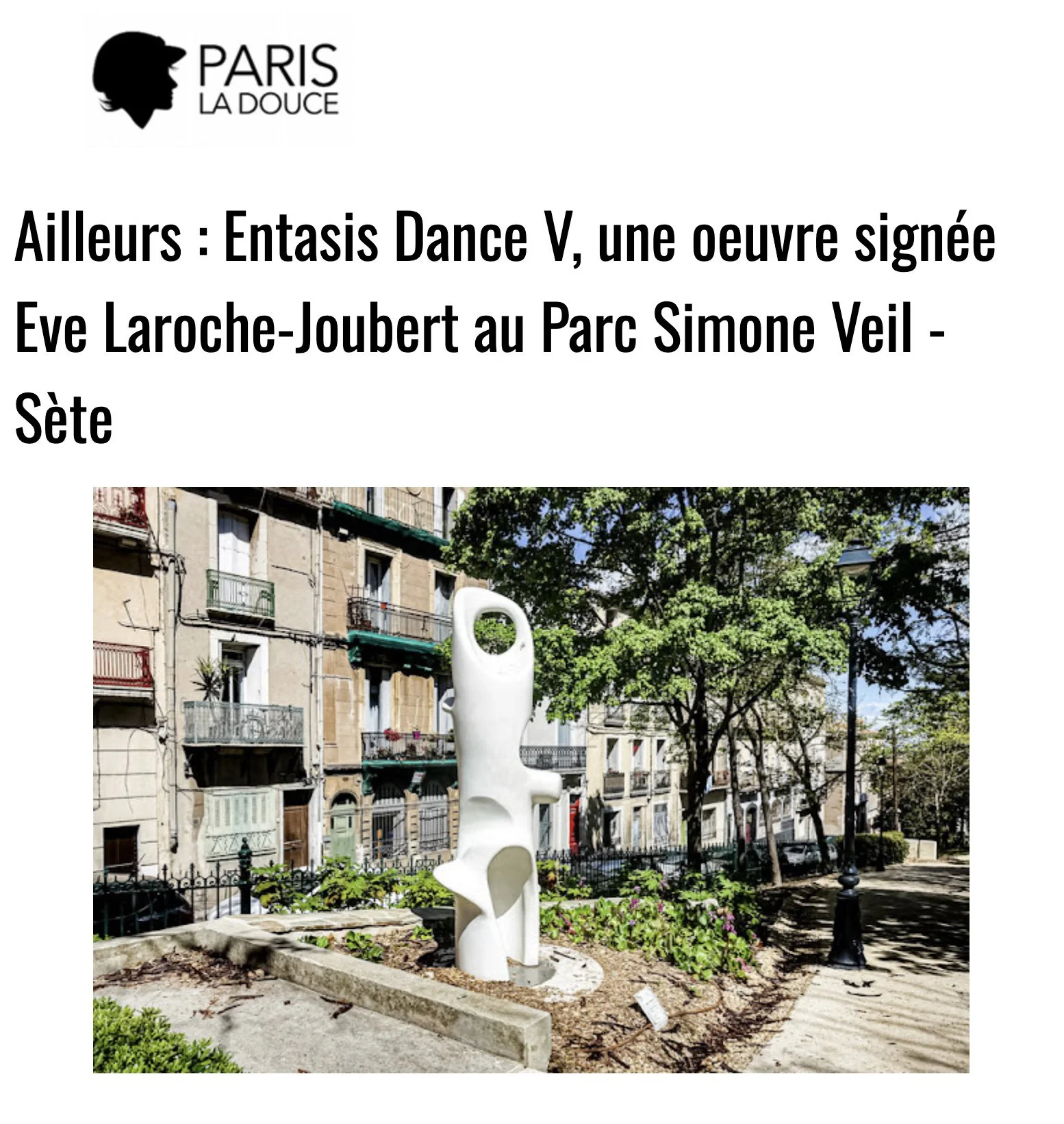
Entasis Dance V - Eve Laroche Joubert - Parc Simone Veil - 7 Rue Député Salis - 34200 Sète
Elsewhere: Entasis Dance V, an artwork by Ève Laroche-Joubert at Parc Simone Veil — Sète.
Acquired by the city of Sète in 2022, Entasis Dance V, a work by visual artist Ève Laroche-Joubert, has found its place at the heart of the Simone Veil Park. In the shade of the century-old trees, the sculpture—its white resin curves inviting touch—evokes the sensuality of a biomorphic artefact. It belongs to the Totems series, a cycle through which Ève Laroche-Joubert seeks to ‘make the body and the mind dance.’ The artist explores the vital relationship between body and material, weaving connections between the sculpted object and danced movement. Her practice sits at the intersection of several disciplines—sculpture, performance, dance, design, and science—following in the lineage of artist-engineers. These experiential works, expressions of a symbiosis between bodily intelligence and the agility of the mind, translate the idea of movement rooted in matter or, conversely, pure abstraction, a virtual suggestion.
Eve Laroche-Joubert deconstructs the hierarchies between body and mind in order to fully embrace the organic nature of her research. She imagines walkable installations that engage visitors and invite them to participate, such as the Bodyscapes series, the Here benches, and the Entasis Dance totems exhibited at the MRAC in 2021. The work Entasis Dance V was presented in this context, in correlation with a choreographic performance by Julia Laporte. The white costume designed by Catherine Sardi heightens the perceptual ambiguity, altering the ability to distinguish the dancer’s body from the object, fused together within the artistic illusion. The moving body becomes one with the plasticity of the sculpture, a living architecture.
Born in Nancy in 1975, Eve Laroche-Joubert received early training in classical dance and music at the Lorraine Conservatory, which would leave a lasting mark on her artistic thinking. In 1996, at the École des Métiers d’Art Olivier de Serres in Paris, she joined the metal workshop of Serge Mouille, designer and coppersmith, a master craftsman. At the Beaux-Arts de Paris, from which she graduated in 2001, she joined the studio of Canadian artist Tony Brown. During her studies, she was awarded the Colin-Lefranc grant and a scholarship from the San Francisco Art Institute, which allowed her to study there for a year as part of an exchange program.
In the New Genres & Sculpture department, she initiated a cycle focused on the body and on the notion of proprioception, which refers to the conscious or unconscious perception of the position of the body’s various parts. Her work turned toward concepts such as positive risk-taking, bodily balance, and the relationship to terrestrial gravity. Eve Laroche-Joubert performed improvisations in public spaces—streets, rooftops—during which she created accumulations from everyday objects. Positioned on these kinetic structures, she sought balance through pendulum-like movements, a fusion of body and mind.
Settled in New York in 2001, she worked under the name Eve Bailey from 2005 to 2015. In January 2018, she set up a studio in Sète, where she explores new resources and inspiring new encounters. Her artistic approach is nourished by an openness to science and technology. She collaborates with the 3D laboratory of the University of Science in Montpellier for the creation of the Bodyscapes cycle—large resin shells, enlargements of elements of the human anatomy.
Coordination of the senses, spatiality, balance — Eve Laroche-Joubert considers physical consciousness as a vector of creativity. The engagement of the moving body, the amplitude of the artistic gesture, seeks to involve the viewer in spatial compositions that shift from the individual to the collective. The range of postures and actions associates thoughts in order to inscribe them into matter. The nature of the movement — and therefore the final form of the work — varies according to rhythm and intensity. A physical and mental experience, both intuitive and concrete, the process undertaken by Eve Laroche-Joubert aims to open new experimental fields and to shape poetic spaces.
By Caroline Hauer: a journalist since the early 2000s, she has lived in London, Berlin, and Rome. Upon returning to Paris — her home port, her city of choice — she created a cultural website in 2011, the beginnings of a new online venture. This first adventure came to an end in 2015. In 2016, she founded the magazine Paris la douce, a webzine dedicated to culture. As publisher, editor-in-chief, and occasionally photographer for the magazine, she writes articles on art, heritage, literature, theatre, and gastronomy.
Ailleurs : Entasis Dance V, une œuvre signée Ève Laroche-Joubert au Parc Simone Veil - Sète.
Acquise par la ville de Sète en 2022, "Entasis Dance V", oeuvre de la plasticienne Eve Laroche-Joubert a trouvé place au coeur du parc Simone Veil. A l'ombre des arbres centenaires, la sculpture tout en courbes de résine blanche appelle à la caresse dans sa sensualité d'artefact biomorphique. Elle appartient à la série des totems, cycle à travers lequel Eve Laroche-Joubert entend "faire danser le corps et l'esprit". L'artiste explore la relation vitale entre le corps et la matière, nouant des relations entre l'objet sculpté et le mouvement dansé. Sa pratique se positionne à l'intersection des disciplines, sculpture, performance, danse, design, sciences, dans la lignée des artistes-ingénieurs. Les oeuvres expériences, expressions d'une symbiose entre intelligence du corps et vivacité de l'esprit, traduisent l'idée du mouvement ancré dans la matière ou bien pure abstraction, suggestion virtuelle.
Eve Laroche-Joubert déconstruit les hiérarchies entre corps et esprit pour embrasser pleinement la nature organique de ses recherches. Elle imagine des installations praticables qui interpellent les visiteurs, les invitent à participer telles que les séries "Bodyscapes", les bancs "Here", les totems "Entasis Dance" exposées au MRAC en 2021. L'oeuvre "Entasis Dance V" a été présentée dans ce cadre en corrélation avec une performance chorégraphique portée par Julia Laporte. Le costume blanc signé Catherine Sardi accentue le trouble de perception, modifie la capacité de discerner le corps de la danseuse et l'objet, fusionnés dans l'illusion artistique. Le corps en mouvement ne fait plus qu'un avec la plasticité de la sculpture, architecture vivante.
Née à Nancy en 1975, Eve Laroche-Joubert suit enfant une formation de danse classique et de musique au Conservatoire de Lorraine qui marquera durablement sa réflexion plastique. En 1996, à l'Ecole des métiers d'art Olivier de Serres à Paris, elle rejoint l'atelier métal de Serge Mouille, designer et dinandier, artisan d'art spécialiste. Aux Beaux-Arts de Paris dont elle sort diplômée en 2001, elle intègre rejoint l'atelier de l'artiste canadien Tony Brown. Au cours de son cursus, elle reçoit les bourses Colin-Lefranc et du San Francisco Art Institute ce qui lui permet d'étudier durant une année au sein de cette école dans le cadre d'un programme d'échange.
Dans le département New Genres & Sculpture, elle initie un cycle lié au corps, à la notion de la proprioception qui désigne la perception, consciente ou non, de la position des différentes parties du corps. Son travail s'oriente vers les concepts de la prise de risque positif, l'équilibre des corps, le rapport à la gravité terrestre. Eve Laroche-Joubert livre des improvisations dans des lieux publics, rues, toits, durant lesquelles elle constitue des accumulations à partir d'objets usuels. Placée sur ces structures cinétiques, elle cherche l'équilibre par des effets de balancier, fusion du corps et de l'esprit.
Installée à New York en 2001, elle travaille sous le nom d'Eve Bailey de 2005 à 2015. En janvier 2018, elle installe un atelier à Sète où elle explore de nouvelles ressources, de nouvelles rencontres inspirantes. Sa démarche plastique se nourrit d'une ouverture aux sciences, à la technologie. Elle collabore avec le laboratoire 3D de l'Université des sciences de Montpellier pour la création du cycle "Bodyscapes", grandes coquilles de résine, agrandissement d'éléments de l'anatomie humaine.
Coordination des sens, spatialité, équilibre, Eve Laroche Joubert considère la conscience physique comme un vecteur de créativité. L'engagement du corps en mouvement, l'amplitude du geste plastique cherchent à impliquer le spectateur dans des compositions spatiales qui d'individuelles deviennent collectives. La palette de postures, d'actes associe des pensées pour les inscrire dans la matière. La nature du mouvement et donc la forme finale de l'oeuvre varie en fonction du rythme, de l'intensité. Expérience physique et mentale, intuitive et concrète, l'expérience menée par Eve Laroche-Joubert tend à ouvrir de nouveaux champs expérimentaux, à façonner des espaces poétiques.
Par Caroline Hauer : journaliste depuis le début des années 2000, a vécu à Londres, Berlin et Rome. De retour à Paris, son port d’attache, sa ville de prédilection, elle crée en 2011 un site culturel, prémices d’une nouvelle expérience en ligne. Cette première aventure s'achève en 2015. Elle fonde en 2016 le magazine Paris la douce, webzine dédié à la culture. Directrice de la publication, rédactrice en chef et ponctuellement photographe de la revue, elle signe des articles au sujet de l’art, du patrimoine, de la littérature, du théâtre, de la gastronomie.
