Ouest France / 03-2021
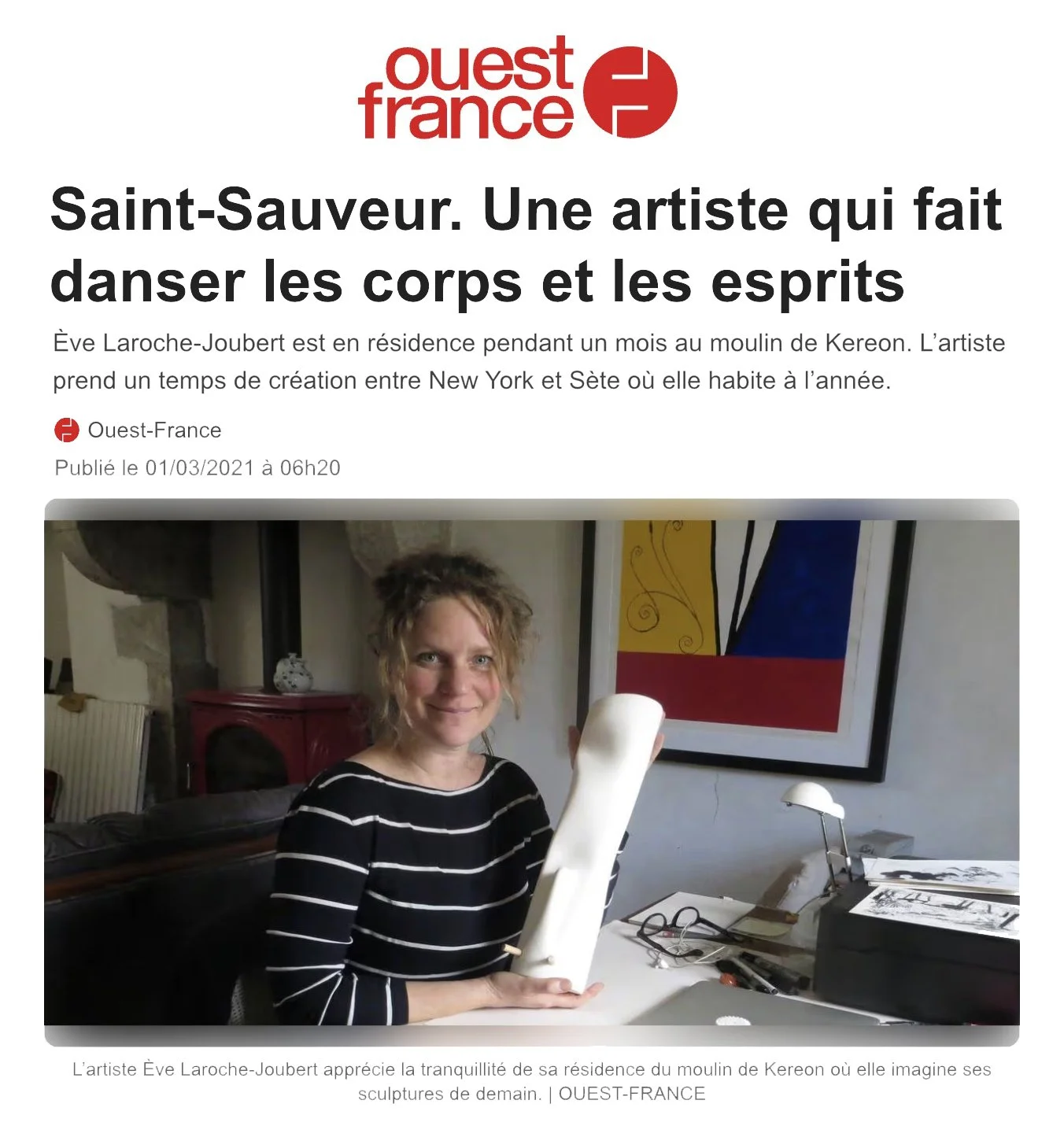
It is surprising to find an artist like Eve Laroche-Joubert in the small village of the Kereon mill, where she is spending a month to recharge and create new works — but above all, to draw in ink at her little desk. “It relaxes me enormously! I’m here at the invitation of a friend from New York whose house is unoccupied for a while. I appreciate the tranquility of the place, and every morning I go for a walk in nature — a kind of small daily adventure along the paths where I often get lost,” she says with a smile. “I know Brittany well; I traveled through it with my parents in a camper van. My first commission was in the Gulf of Morbihan — it was a wrought-iron gate.”
A life lived between New York and Sète
“Human encounters and openness to science and technology are the intrinsic values of my artistic practice,” recalls the artist, born in Nancy in 1975. “I consider that intelligence does not come solely from the brain, but from the entire body. I see myself as part of the tradition of the artist-engineer, blending sculpture, dance, architecture, and design.”
Trained in classical dance and music at the Conservatory, she was very early drawn to the simple mechanical laws of construction games, which she later deepened at the School of Applied Arts in Paris. “In my visual work, I explore themes such as trust, positive risk-taking, the balance of bodies, and our relationship to earthly gravity.”
The first sculptures she made with her own hands featured dancers in striking public performances. Awarded the Colin Lefranc Fellowship, Eve was invited to San Francisco, where she made important connections. In 2002, she moved to New York and began improvising in the streets. “I pushed my body to the limits of my own balance in public performances that challenged preconceived ideas of behavior,” she says. Several of her sculptures were exhibited at the foot of the iconic Central Park.
Today, the artist has returned to France, settling in Sète, where she imagines new structures to make others dance — professionals or not. “I have several commissions and no more pieces in stock, so I’m working on new giant totems so the public can also use them as dance objects.”
Surprenant de trouver une artiste comme Ève Laroche-Joubert dans le petit village du moulin de Kereon où elle passe un mois pour se ressourcer et créer de nouvelles œuvres mais surtout, dessiner à l’encre sur son petit bureau : « Cela me détend énormément ! Je suis ici à l’invitation d’une amie de New York dont la maison est inoccupée pour un temps. J’apprécie la tranquillité des lieux et, tous les matins, je me balade dans la nature, une sorte de petite aventure quotidienne dans les sentiers où je me perds souvent, sourit-elle. La Bretagne, je connais pour l’avoir sillonnée avec mes parents en camping-car. Ma première commande, je l’ai réalisée dans le golfe du Morbihan. C’était un portail en fer forgé.»
Une vie rythmée entre New York et Sète.
« Les rencontres humaines et l’ouverture aux sciences et à la technologie sont les valeurs intrinsèques de ma démarche artistique, rappelle l’artiste née à Nancy en 1975. Je considère que l’intelligence n’est pas le fait du cerveau uniquement mais bien du corps dans sa globalité. Je m’inscris dans la tradition de l’artiste ingénieure, mêlant sculpture, danse, architecture et design.»
Formée à la danse classique et à la musique au Conservatoire, elle est très tôt attirée par les lois mécaniques simples des jeux de construction, qu’elle va approfondir à l’École des arts appliqués à Paris. « Dans mon œuvre plastique, j’aborde des sujets comme la confiance, la prise de risque positif, l’équilibre des corps et notre rapport à la gravité terrestre.»
Les premières sculptures fabriquées de ses mains mettent en scène le danseur dans des performances en public remarquées. Lauréate de la bourse Colin Lefranc, Ève est invitée à San Francisco où elle fait de belles rencontres. En 2002, elle s’installe à New York et se lance dans des improvisations en pleine rue. « J’ai poussé mon corps dans la limite de mon propre équilibre dans des performances en public défiant l’idée de comportement préconçu », raconte l’artiste. Plusieurs de ses sculptures sont exposées au pied du célèbre Central Park.
Aujourd’hui, l’artiste est rentrée en France à Sète où elle imagine de nouvelles structures pour faire danser les autres, professionnels ou pas. « J’ai plusieurs commandes et je n’ai plus rien en stock alors je travaille à de nouveaux totems géants pour que le public puisse lui aussi, les utiliser comme objets de danse. »
